Osteonecrosis of Hip
Osteonecrosis of the Hip
The hip joint refers to the ball and socket joint that joins the thigh to the pelvic bone and is located deep to the groin fold. In India, many people refer to the lower portion of the back bone as hip. However, in technical terms, lower back (top of the buttock region) and hip are different entities. The ball of the hip joint is formed by the top of the thigh bone (femur) and is called femoral head. The ball part of the hip joint may loose its blood supply resulting in a condition called osteonecrosis or avascular necrosis of the hip joint. This condition commonly affects both hip joints. It is a common hip disorder in India.
Cause
In many cases, the exact cause of avascular necrosis cannot be identified. Alcoholism is a known predisposing factor for this condition. Steroid medications taken in high doses for certain conditions such as SLE, rheumatoid arthritis, asthma can also cause osteonecrosis. It is also associated with some diseases such as sickle cell disease, SLE, blood disorders etc.
Symptoms
When the blood supply to the femoral head is lost, the bone dies. This may lead to increased pressure within the bone and cause pain. The bone supporting the cartilage tends to break down and is called collapse. Once the head collapses, it permanently loses its smooth spherical 'ball' shape. The movement in the joint looses the smoothness and becomes rough. This invariably progresses to arthritis of the hip joint. A person with this end stage condition often has pain in the groin or buttock region and becomes limited in his or her ability to walk and carry on several activities of daily living. The progression from avascular necrosis to end stage arthritis happens over a few years.
Diagnostic Tests
Xrays and MRI scans are commonly used to detect osteonecrosis and stage the severity of the problem.
Treatment
Medicines for osteonecrosis:
As mentioned earlier, loss of shape of the femoral head is a key event in the progression of osteonecrosis. If this is prevented, one may avoid the progression to arthritis. A class of medicines called bisphosphonates have shown promise in preventing bone collapse and change of shape. Avoiding high impact activities may also be helpful in this regard. However, once collapse has occurred, these medicines may not be as helpful. It is therefore beneficial to identify the problem early and initiate treatment. In later stages, when arthritis has set in, anti-inflammatory medications, cane walking, exercise therapy and physiotherapy may be used by your orthopaedic doctor.
Surgical treatment for osteonecrosis:
In significant sized lesions or in advanced stages of the disease, when the ball has lost its shape and continues to be painful, surgical treatment may be necessary.
Core Decompression
Core decompression is procedure that relieves pressure within the femoral head and allows restoration of blood supply to the femoral head. This is done by surgically creating channels in the femoral head using special drills. Core decompression may be combined with injection of processed bone marrow that stimulates the healing potential of bone. Core decompression is ideally done before the ball loses its shape so that it prevents collapse and the development of arthritis. It is successful in 25-85% of cases depending on the stage of the disease.
Total Hip Replacement
Total hip replacement may be necessary in advanced stages of the disease when the ball part has lost its shape and continues to be painful, limiting the activities of daily living. It is a boon to young patients with osteonecrosis as it has great success in giving dramatic pain relief and improving function. It is considered one of the most successful operations in all of medicine
Click here to learn more about total hip replacementThe Xray of a patient with osteonecrosis and severe collapse .
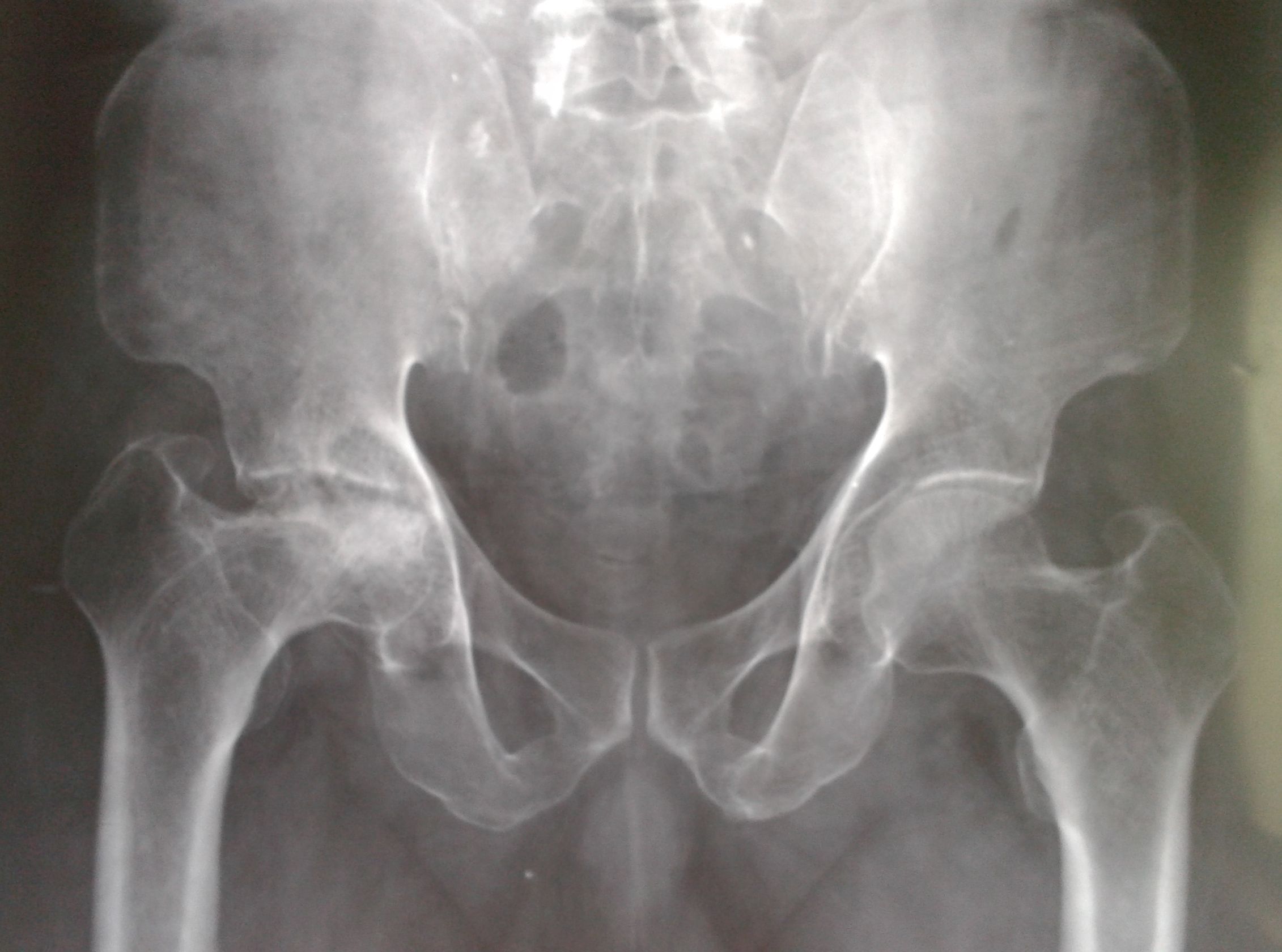
The loss of shape of the ball of the hip joint is obvious in comparison to the left side. He had severe difficulty with walking. This was treated with hip replacement, the xray of which is
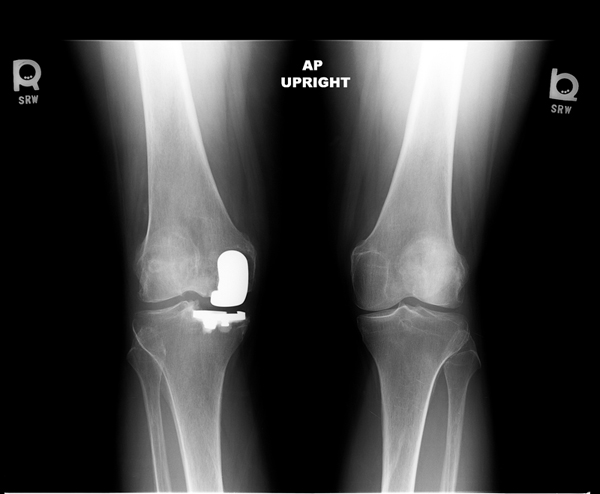
He returned to painless walking without the use of any walking supports.
Hip Fracture
The hip is the portion that joins the thigh to the pelvis. It is a ball and socket (cup) type joint. The thigh bone (thigh bone) forms the ball part of the hip joint. Hip fracture involves a break of the upper end of the thigh bone.
Hip fractures commonly occur in old patients when bones become weak.. People with osteoporosis are a high risk of sustaining hip fractures from minor injuries such as even missing a step or ground level fall. Hip fractures can sometimes occur in young patients from accidents and other such high velocity injuries
How to prevent hip injuries and fractures?
There are two basic strategies to prevent hip fractures in the elderly: strengthening the bones and preventing falls.
How to maintain strength of bones in old age?
All people over 50 years of age must make a conscious effort to preserve their bone health, given the high incidence of osteoporosis. Food must provide adequate quantities of calcium and vitamin D. Good sources of calcium include milk and milk products such as curd and cheese, ragi, almonds, chicken, fish, prawns etc. Exposure to sunlight helps the body in forming vitamin D. Any body part that is not used regularly tends to lose its health and the bones are no different. Daily weight bearing exercise such as walking, jogging are essential to maintain bone health. A minimum of 20-30 minutes of exercise at least 5 times a week is strongly recommended. This is apart from regular household activity such as working in the kitchen. Please refer to our section on diet for bone heath
What is the treatment for weak bones or osteoporosis?
It is well known that nearly one in 5 males and one in 3 females above the age of 50 years suffer from weak bones which is termed osteoporosis. Osteoporosis can be detected by a special type of scan called DEXA scan. Consult your doctor about testing of your bones for their strength. When your bones are osteoporotic, just using calcium supplements will not be helpful enough. You might need initiation of specific anti-osteoporosis medicines, apart from calcium and vitamin D supplementation. If osteoporosis is not treated, then he or she is at a high risk of sustaining fractures of the back, hip and wrist from minor injuries. Such fractures, especially those of the hip may be life changing events. It is therefore imperative to diagnose and treat osteoporosis before it is too late.
How else to avoid hip fractures?
As outlined earlier, hip fractures can result from minor falls in old age. Therefore, avoiding falls is an effective method to prevent hip fractures. Good lighting in the house, especially in the staircase is necessary. Hands railing along the stairs and in the bathroom are extremely helpful for the elderly. Avoid placing loose doormats and other such items on the floor that you might trip over. When getting up in the middle of the night to go to the restroom, make sure you are balanced before you start walking. Keeping the light switch next to your bed will help you turn on the light before you have to walk some distance in the dark. Remember that a slight disturbance from turning on the light is far less stressful on the person with you than you sustaining a hip fracture.
Is surgery necessary for hip fractures?
Most hip fractures in the elderly are major injuries that will not allow the patient to bear weight on the affected leg and he or she will be unable to walk. Traditional methods of treatment such as bandaging and bed rest do not work well in hip fractures and lead to prolonged recumbence. In old age, such people are at risk of developing bedsores and lung complications which are difficult to treat. It has been shown that early surgery is highly beneficial in hip fractures and is the standard treatment in the developed countries.
Is hip fracture surgery safe in older people?
Elderly people planned for a hip fracture need to be carefully assessed to determine their fitness for surgery and anesthesia. This generally requires blood tests, xrays, ECG, and sometimes ECHO testing for the heart. Once the testing is completed your surgeon and anesthetist will discuss the finding with you and your family and explain the risks of surgery versus risk of not doing surgery to help you take a decision. Large studies have shown that in most cases the benefits of surgery far outweigh the risks as the risk from nonoperative management is high.
What type of surgery will be needed for hip fractures?
Most hip fractures require surgical fixation by screws, plates or nails. The choice of the implant will depend on the fracture and the preference of your surgeon. When such fixation is done, the fracture takes 6-12 weeks to heal and you may be required to use a walker or crutches till the fracture heals. Occasionally hip replacement surgery may be necessary for hip fractures.
When is hip replacement needed for hip fractures?
In old people, fractures involving the upper end of femur inside the hip joint, technically termed as intracapsular fractures have suboptimal results with screw or plate fixation. Hip replacement in such cases avoids most of the complications and has a very high success rate. Also, when screws or plates used for hip fracture fixation have failed, hip replacement surgery may be required. Hip replacement in this scenario involves either a hemi replacement (replacement of the ball part alone) or a total hip replacement (replacing the ball and the cup), depending on the functional status of the individual. When a hip replacement is done, most patients are able to walk in 1 or 2 days from the day of surgery.
Hip Replacement
Hip replacement refers to replacement of the damaged ball and socket parts with artificial joint where a metal ball rotates inside a cup part lined with smooth plastic.
Read MoreWarning: session_start(): Cannot send session cookie - headers already sent by (output started at /home2/edotsind/public_html/jayamhospital/hip.php:404) in /home2/edotsind/public_html/jayamhospital/html.php on line 3
Warning: session_start(): Cannot send session cache limiter - headers already sent (output started at /home2/edotsind/public_html/jayamhospital/hip.php:404) in /home2/edotsind/public_html/jayamhospital/html.php on line 3