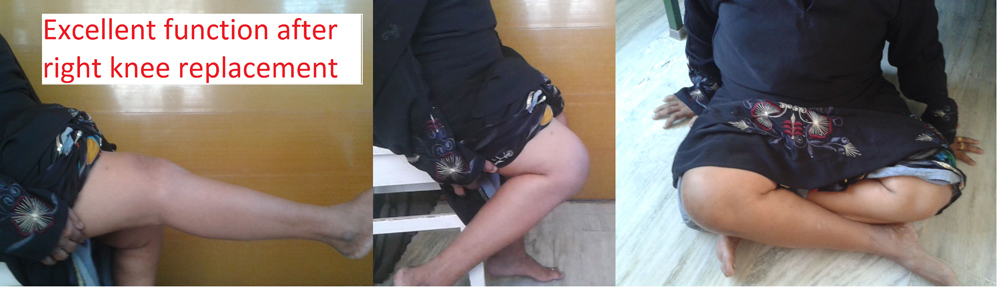
Excellent function after knee replacement
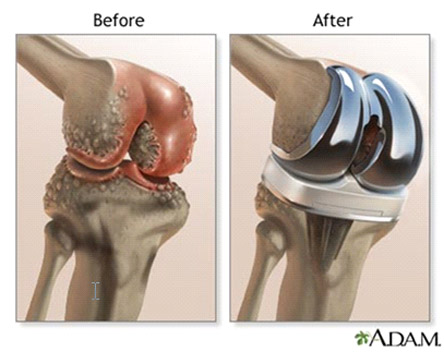
Total Knee Replacement is a surgery where we recap the ends of the bone with artificial parts that would substitute the cartilage that has been damaged by arthritis. See the figure below.
Dr Arun Kannan specializes in the following special types of knee replacement
Oxinium knee replacement, Hi flexion knee replacement, 3D knee replacement, Patient specific knee replacement
When does one need knee replacement surgery?
Knee replacement is done only for people who have severe arthritis that has not responded to medicines, exercises and injections. It should not be done in people in people with mild arthritis or in those without significant limitations from knee arthritis. We generally do not do it in those who can comfortably walk for 20-30 minutes without pain.
Can it be done in old people?
Knee replacement is a surgery meant for people 55 to 60 years of age. In fact, it should be avoided in younger people. If the general condition of the patient is suitable as determined by preoperative testing, knee replacement is an extremely safe surgery. In the United States, the mortality following knee replacement is lower than that of general population of the same age (http://www.data360.org/dsg.aspx?Data_Set_Group_Id=587 and Medicare data from the USA, JAMA, 2012).
Can old people withstand the surgery?
Old people not only withstand the surgery, but do remarkably better following the surgery. Most patients are able to stand and walk the very next day after the surgery.
How successful is knee replacement surgery?
Knee replacement is an extremely successful surgery with >90-95% of people doing well for 15 years. Western countries have community based registries that track all knee replacements for long period of time and 90-95% success rates have been shown in many countries like USA, UK, Austraila and Sweden using these nationwide registries.
How should I prepare for knee replacement ?
Knee replacement is almost always an elective surgery and should generally not be done on an emergency admission. You will be asked to do blood tests, Xrays, ECG and other tests to make sure that overall health is good and optimal for knee replacement. We then fix a date for the surgery, so that you can plan your schedule and time off from work. This will also allow family members to plan their schedules around the time of surgery. It is also a good idea to visit the hospital and have a look at the facilities such as rooms, cafeteria, nearby places and the staff. You should get any pending dental work completed prior to the surgery. For a week before the surgery, you should avoid getting any skin wounds or pricks and be relaxed. We generally admit patients to the hospital one day before the date of the surgery.
How is knee replacement surgery done?
Knee replacement is done in an ultra clean operating theatre to minimize the chances of infection. You will generally be given spinal anesthesia that will make both the legs numb and pain free. Sometimes, general anesthesia may be required. The incision is made on the front of the knee. The damaged bone ends are shaved and shaped to accommodate the knee prosthesis. The bones are sized and the knee prosthesis that matches your size accurately is fixed like a cap at the end of the bone. A special plastic allows smooth movements between the capped bone ends.
How much blood loss happens with knee replacement?
Blood loss is usually not a major issue with knee replacement. We use a tourniquet during surgery and therefore very litlle blood is actually lost during the surgery. To prevent postoperative blood loss, we use a special medicine called tranexamic acid that is administered at the end of surgery. This minimizes bloos loss and patients hardly require any blood transfusion after the surgery.
How do patients recover from knee replacements ?
With our current techniques adopted from some of the World's best centres for joint replacement surgeries, we have are able to do knee replacement with small incisions and without damaging the muscles. Blood loss is minimal and it is very rare for a patient to require blood transfusion following surgery. Generally, patients are made to stand and walk the very next day after knee replacement. The general timetable followed by most patients is given below.
What can one expect after a successful knee replacement?
One should be able to walk without pain after knee replacement surgery. He or she must be able to carry out activities of daily living without knee pain after knee replacement surgery. One should have realistic expectations from a knee replacement before undertaking the procedure. While it allows pain free walking and most people are able to do swimming, golf, driving, light hiking, biking, ballroom dancing, and other low-impact sports, it should not be expected to make your knee as good as it was when you were young. Squatting and kneeling may not be possible after a knee replacement surgery in some patients.
What are the long term precautions after knee replacement?
1.We are extremely careful about infections after knee replacements. If patient with knee replacement develops infection like skin infection, teeth infection or respiratory infection, he or she should immediately consult a doctor and take antibiotics if infection is suspected. We also recommend that they take antibiotics before any invasive procedure such as tooth extraction.
2.They should visit their orthopaedic surgeon at regular intervals and have their knee checked. Generally, we do Xrays at 3 months, 1 year, 2 years, 5 years and 10 years after knee replacement. Beyond that it would depend on the individual case.
What brand of knee implant or prosthesis should I get?
There are several manufacturers for knee implants. The five major manufacturers who are internationally renowned include Depuy, Zimmer, Stryker, Smith and Nephew and Biomet. While it is difficult to pick one over the other in broad terms, one can be comfortable in the thought all of them have the same basic concepts. The one that your surgeon is comfortable using should be the best implant for you. We use the best knee replacement implants available from these manufacturers and they are the same as the ones widely used in the United States.
What is the cost of knee replacement?
The implant cost is the major cost involved in knee replacement and usually accounts for approximately 50% of the total cost. The cost of knee replacement is therefore heavily dependent on the cost of the imported prosthesis that is used. We will discuss the implant options that would be best for your situation during the consultation. The discussion will also include the costs involved with the implant and the surgery.
What is computer guided knee replacement?
Computer guided navigation has been used in knee replacement to enhance accuracy with component positioning. A special navigation system is used that directs the surgeon to place the components in an accurate manner. This had gained popularity in USA nearly 10 years back. This has now declined in popularity as we now have a more advanced technology with us. In this new technology, we are able to obtain special scans of the knee joint and manufacture specific instruments shaped according each patient. This technology is believed to be even superior to computer navigation. This is called patient specific instrumentation for knee replacement. It involves obtaining MRI or CT scans of the knee and waiting for a month to manufacture instruments shaped specifically for your knee.
Warning: session_start(): Cannot send session cookie - headers already sent by (output started at /home2/edotsind/public_html/jayamhospital/total_knee_replacement.php:452) in /home2/edotsind/public_html/jayamhospital/html.php on line 3
Warning: session_start(): Cannot send session cache limiter - headers already sent (output started at /home2/edotsind/public_html/jayamhospital/total_knee_replacement.php:452) in /home2/edotsind/public_html/jayamhospital/html.php on line 3