What is 'ACL'?
The knee joint is dependent on its ligaments for maintaining stability. The most important ligament of the knee is probably the anterior cruciate ligament (ACL). The ACL runs in an oblique fashion in the middle of the knee and connects the femur and the tibia. Injury to the ACL is one of the commonest injuries of the knee. It is especially common amongst football players and other sportsmen. Injury to the ACL is commonly associated with injuries to other structures in the knee joint such as articular cartilage, meniscus and other ligaments.
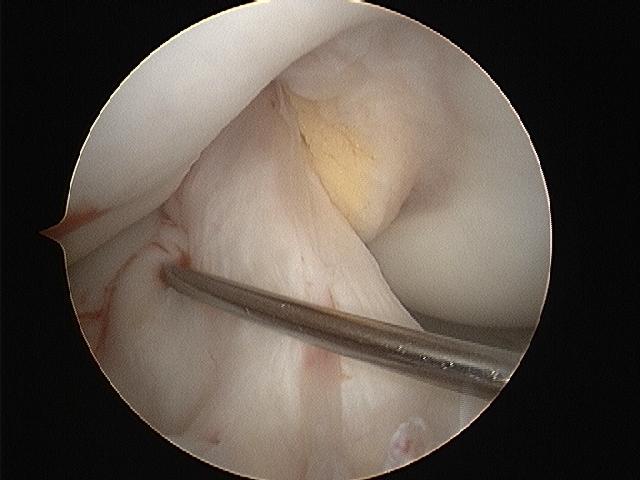
The ACL as viewed through an arthroscope
How is ACL injury detected?
ACL injury happens during sports injuries that involve sudden change in direction, sudden stopping, improper landing from a jump or a direct collision. It may also occur after accidents. When ACL is injured in such cases, one may hear a pop. The knee swells up within 24 hours from the injury. The swelling may subside after that, over a few days. One often feels a sensation of instability when walking. A doctor would suspect an ACL injury when these happen.
Orthopaedic examination with the patient relaxed is the standard method of used to detect this injury. This may be confirmed further with an MRI scan of the knee. Xrays are also obtained when ACL injury is suspected to detect any bony injury that may occur in conjunction with an ACL tear.
Why does ACL injury need treatment?
A torn ACL will not heal by itself. When the ACL is torn, the knee loses its stability and people often feel unstable when walking. When the knee moves in an unstable manner, the meniscus and cartilage are at a higher risk of injury. This may lead on to irreversible arthritis of the knee joint. The aim of treating ACL injury is to prevent instability and avoid arthritis of the knee joint.
How is ACL injury treated?
Initial treatment after an ACL injury comprises of rest, ice, compression (bandaging) and elevation (commonly referred to as RICE protocol). This is intended to reduce the pain and discomfort of ACL injury. A knee brace may be used additionally to protect the knee. An exercise program may then be initiated to allow return of full movement in the knee. Pain and swelling subside and full knee movement is gained generally by 2- 3 weeks. Further treatment will depend on the patient's age and level of activity.
A torn ACL will not heal without surgery. For young active individuals, surgery is often required. For older people with limited activities, a rehab program is pursued that will allow them to function reasonably well without the ACL.
What type of surgery is needed for ACL injury?
Following ACL injury, most people are treated with ACL reconstruction that involves augmenting the ACL with a tendon graft. ACL reconstruction is accomplished with athroscopic techniques and small incisions. Therefore, the pain is less and recovery is quicker after surgery. The recovery and prognosis also depend on the integrity of the other structures within the knee joint.
Warning: session_start(): Cannot send session cache limiter - headers already sent (output started at /home2/edotsind/public_html/jayamhospital/ACL_Injury.php:327) in /home2/edotsind/public_html/jayamhospital/html.php on line 3